
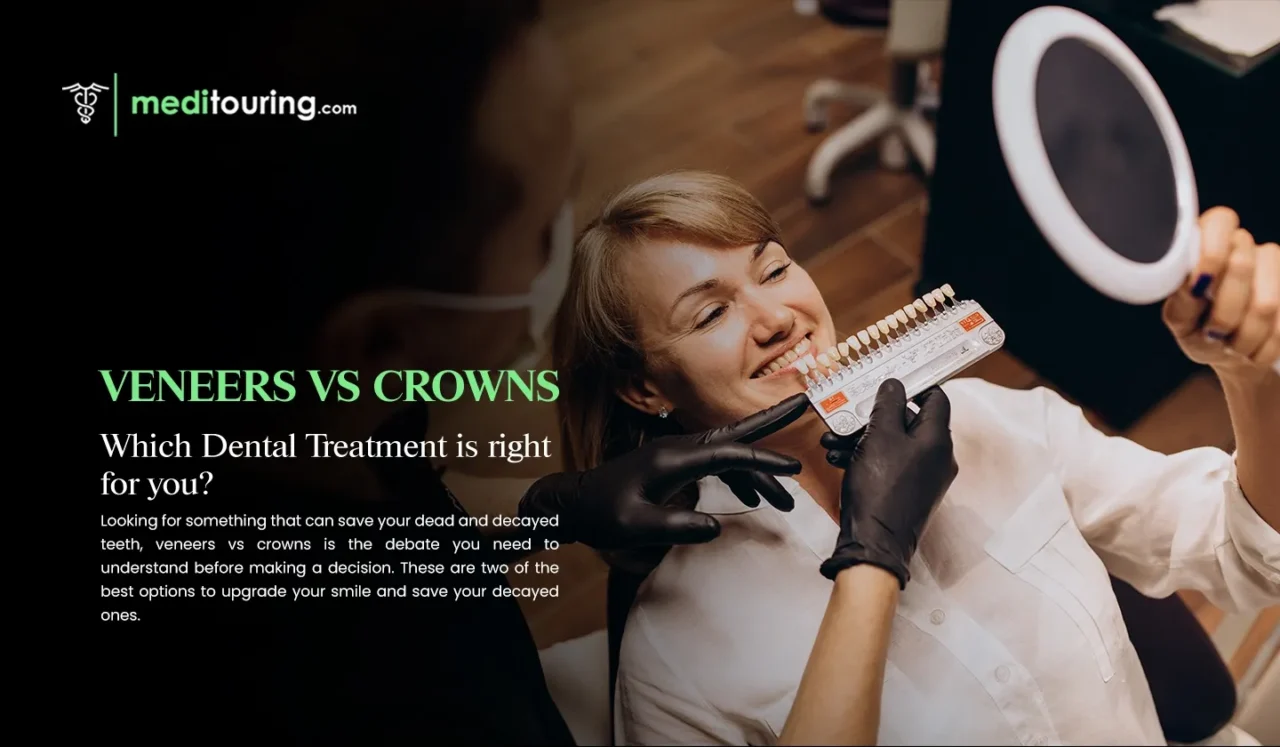
Looking for something that can save your dead and decayed teeth, veneers vs crowns is the debate you need to understand before making a decision. These are two of the best options to upgrade your smile and save your decayed ones. Veneers are made up of ultra-thin ceramic shells bonded to the front of the teeth for cosmetic enhancement. On the other hand, crowns are full-coverage caps made for heavily decayed structures or damaged teeth.
Hence, to get the right procedure for specific dental goals, you need to understand the basic differences between veneers vs crowns. Understanding the difference between veneers and crowns, you can easily evaluate the pros and cons without compromising on quality, and it’s the best way to optimize your smile reconstruction.
Understanding Dental Crowns vs Veneers
If you want to choose between dental crowns vs. veneers, you must first understand why these two options are best for your teeth transformation. These two options can completely change your smile; it can become difficult to decide between veneers vs crowns because it can change the way you interact with your natural tooth tissues.
Dental Veneers – The Conservative Aesthetic Option
Veneers are made up of ultra-thin, customized ceramic lenses, which bond directly to the front visible surface. They are helpful in hiding those discoloration marks, covering surface chips, and correcting minor misalignments. Veneers are delicate, and many choose to get dental veneers abroad, as they need minimal alteration without damaging the healthy natural tooth. Doctors will shave away only a tiny fraction of enamel around 0.3 to 0.5 mm from the front surface. Hence, making veneers the best option for a conservative smile makeover.
Dental Crowns – The Full Coverage Protection
In comparison between veneers vs crowns, crowns act as a full-coverage cap made to encase the entire damaged tooth down to the gum line. It’s a more aggressive approach, as you lose tooth structure around the full circumference of the tooth. Dentists shave the tooth down to a small core (up to 2 mm of structure) to make room for a thick ceramic cap. Crowns remove more natural structure, but in exchange they redistribute heavy biting forces across the jaw and protect the tooth from breaking or fracturing.
Dental Crowns vs. Veneers — Technical Comparison
In this table, we can see how veneers vs. crowns help in restoring the overall tooth structure.
| Feature | Dental Veneers | Dental Crowns |
|---|---|---|
| Coverage Area | Front visible surface only | Complete 360-degree encasement |
| Enamel Removal | Minimal (0.3 to 0.5 mm) | Significant (up to 2 mm) |
| Primary Clinical Focus | Cosmetic enhancement & aesthetics | Structural reinforcement & protection |
| Reversibility | Highly conservative; preserves enamel | Permanent; tooth always needs a cap |
| Average Lifespan | 10 to 15 years with proper care | 20+ years if protected from grinding |
| Best Material Choice | E-max Rigid Lithium Disilicate | High-Tensile Zirconia or Ceramic |
Veneers vs Crowns — Which Option Is Best?
The right choice really comes down to your tooth’s current condition and your treatment goals. Here’s how to tell which one fits your case.
When to Choose Veneers
If you want to fix superficial flaws on a natural tooth that is otherwise sturdy, veneers are the conservative option. This side of dentistry focuses on managing discoloration and altering shape without sacrificing the naturally strong structural integrity. Veneers are best for people who have:
- Severe intrinsic tooth stains or discoloration
- Minute chips, wear, or cracks within the surface
- Small gaps between teeth (diastemas)
- Slightly uneven, oddly shaped, or crooked teeth
Veneers are available in premium-quality material such as E-max lithium disilicate ceramic, which allows light to pass through the way natural enamel does. Ceramic also helps in gaining a flawless and bright smile transformation without damaging your original dentine.
Choosing a Crown for Damaged Teeth
Picking the right option for a crown or veneer for damaged teeth depends on your natural tooth structure and how much enamel remains. Veneers are delicate and cannot bond with heavily infected teeth or ones with broken surfaces. For this, you’ll need a heavy-duty, full-coverage cap to fix:
- Large structural fractures or badly broken teeth
- Advanced decay, where a significant portion of the natural tooth has lost its enamel
- Teeth that have undergone root canal therapy, which tend to become brittle
- Teeth affected by grinding (bruxism), which need more durable restorations, such as zirconia crowns
The Rise of Dental Tourism: How to Save Money Abroad
Getting a cosmetic dental procedure done privately can come with a hefty price tag, which is why more people are exploring treatment abroad. If you’re looking for veneers abroad, it’s worth checking out providers like Meditouring, which puts together premium dental packages with high-quality clinical care, local transfers, and personal assistance — so you can travel for treatment without any hassle.
Cost Comparison: Veneers vs Crowns
Here is a simple comparison to understand veneers cost vs. crowns cost between the UK and Italy.
| Treatment Type | Average UK Cost (Per Tooth) | Average Cost in Italy (Per Tooth) | Your Total Savings |
|---|---|---|---|
| Dental Veneers | £850 – £1,300 | £250 – £350 | Save up to 70% |
| Dental Crowns | £750 – £1,200 | £220 – £320 | Save up to 73% |
Pros and Cons: Veneers vs Crowns
There are many reasons to choose veneers or crowns based on your dentist’s advice. Every procedure has its own advantages and disadvantages that you need to understand before making the final decision.
Dental Veneers
- The main advantage of veneers is an aesthetic smile that preserves most of your enamel, avoids gum-line irritation, and resists staining over time.
- However, veneers are made of a more delicate material that can’t withstand heavy bite forces, aren’t suitable for badly decayed teeth, and need a strong layer of enamel to bond to.
Dental Crowns
- Dental crowns have unmatched structural integrity, cover severe fractures, offer stability for chewing, and protect teeth even after root canals.
- The procedure requires shaving the tooth down on all sides, is completely irreversible once done, and can leave the tooth more sensitive to hot and cold temperatures.
Conclusion
Hence, if you want to balance your cosmetic requirements with dental needs, it’s a necessary debate between veneers vs crowns. The two types of restorative procedures serve different purposes — one enhances structural damage, and the other supports complete smile transformation. Veneers offer brilliant yet minimally invasive solutions to enhance the shape, color, and alignment of healthy teeth. On the other hand, if the tooth is completely gone, severely decayed, or weakened due to root canal therapy, you would need a full-coverage crown for long-term reinforcement and restoration. Understanding the basic difference between veneers vs crowns can help you find the right option for a functional and beautiful smile that lasts for decades — and with Meditouring, you can get that treatment done affordably in Italy.
Frequently Asked Questions
Yes, natural tooth structure remains vulnerable at the gum line if plaque accumulates under either restoration.
Veneers typically last 10 to 15 years, while durable crowns can last over 20 years.
No, because the aggressive 360-degree shaving process permanently removes the enamel required for a veneer.
Yes, traveling for cosmetic dentistry, such as to Italy, can save patients up to 70% compared to average UK treatment costs.
A full crown is mandatory if the tooth has lost more than half its natural structure or undergone a root canal.